
Following the birth of our first foal I am reminded just how educational and not to mention how mouthy foals can be. Which brings me to my first topic, curiosity. Have you ever baby sat or possibly given birth to a child that asks questions like there’s no tomorrow? Like they will suddenly combust with how fast they fire off questions? Though this may test our patience to the brink of googling the morality of taping their mouth shut it’s also a blessing in disguise. Children learn by asking questions, think back to when you may have seen a child point at something or that yearning little open-hand motion they do when they REALLY want something but can’t speak. Are you tearing up yet remembering how adorable your children use to be? Before they could talk back, walk-in on you pooping, and demand your food. Think of foals the same way, they start exploring the world the minute they wake up. Touching, smelling, and “asking” things. Ok and yes.. kicking them too. I shudder thinking about the Charlie-Horses I have received from those little hooves, who’s with me?!
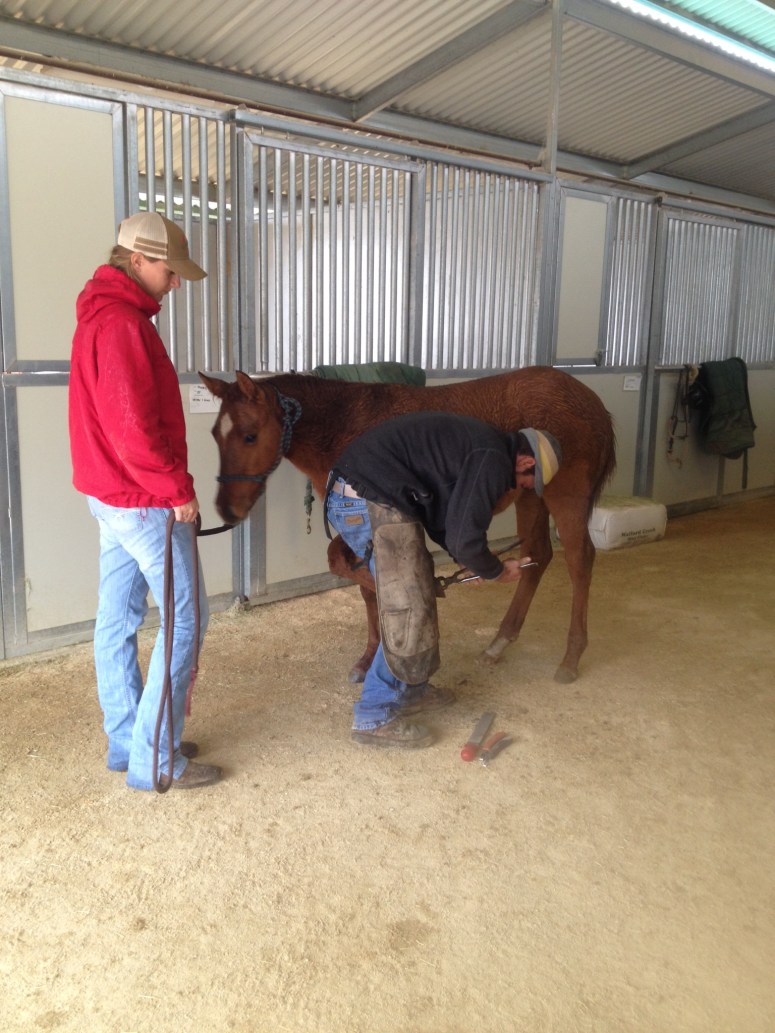
So how do they “ask”? One of the best moments I can remember from halter breaking my first filly was when she was getting her feet trimmed for the first time and she bumped her nose on my arm. A small and maybe insignificant gesture to some but I melted. She was unsure of the moment with this strange person and needed reassurance from a person she trusted. She “asked” me if it was an ok moment, by giving her a quick pet letting her know the moment was not one of fear she stood there like she’d been having her feet trimmed for years. Here’s that moment:
A man I whole heartedly look up to, Buck Brannaman, has an incredibly simple and effective way of working with horses. In an article with Patricia Sellers Buck advised three basic steps when working with horses (it works with people too):
“1. Adapt. When people come to me with horse problems, I find I’m usually helping the horse with people problems. It’s the horse’s owner that typically needs to adapt to shape the horse into a winner. With horses and employees, resist casting them in an unflattering light, as if they’re some stubborn animal in need of breaking. They need assurance and confidence. If you have an idea, let it become their idea.
2. Detach. Some people call this “conflict resolution” because humans are inclined to see conflict when they encounter a strong will. My advice: Don’t take it personally. You might think you’re pretty important, but don’t flatter yourself. You’re not so important to the horse. If the horse was bucking you off, it’s because you put him in a position where he felt a need to defend himself. Remember the old saying, “He who angers me, owns me.”
3. Dance. Think of the horse as your partner. And it’s all one great dance. That’s not to say it’s always going to be easy or you won’t have to work through issues. But when a horse is troubled or uncomfortable in our world, rather than show contempt for him, you must demonstrate empathy and work to convince him that you mean him no harm. You have some things that you’d like him to do with you–as opposed to for you. And the best way to do that is as partners. ”
Number three is my favorite.
Foals will constantly “ask” their mothers throughout the day if they should be afraid or not. Mares are some of the most patient mothers on the planet, usually, they do not “beat” their children or scream at them when they “ask” questions or touch things. Foals look to us for the same guidance. Like most babies foals have a certain energy that matches that of the Energizer Bunny. They run, they jump, they kick, and they touch EVERYTHING. All the while, at least for the first couple of days or so, mom is running right behind them nickering at them to calm the hell down. Mares get kicked, jumped on, and bit constantly, you should feel so lucky that your child isn’t this way one day post birth.
Foals give us a chance to peek into the innate behaviors of the horse. They are the most pure form a horse will ever be. In college I had to write a ridiculously long paper on equine behavior, there was no required page length but ‘previous papers turned it were on average 15 pages’. So naturally everyone wrote 20 pages, most of us were freshmen and over-achievers. The assignment was to go out into the yearling stud colt herd on campus and observe certain behaviors, herd hierarchy, playing, fighting, etc. You learn a lot watching horses in a herd setting such as how they naturally react to stimuli and with each other. Horses are naturally curious animals, they may think everything has nasty claws and sharp teeth but being a prey animal doesn’t really set them up for much bravery. On occasion there are the ones that are brave from the get go, but most of the time they have to be shown an item or person isn’t going to kill them. Foals tend to exhibit a certain level of bravery purely because they haven’t yet been shown or experienced what to be afraid of yet. Mom does a great job of setting them up for most things in life but we as owners and trainers have taken on the continuation of that role once they are weaned.
Why are babies THE best? They teach us patience. Not all foals are the same, just like not all children are the same. Some children ask question after question without taking a breath and some children are shy. Foals are similar, some will test your patience and some will make you feel like they understand the words coming out of your mouth. Being angry with a horse usually stems from you not communicating in a way the horse can understand. They aren’t born with the understanding of what it means to be tamed. And boy do some of them let you know, cringing again from the thought of little hooves and bruises. Time is your best ally.
Time is my second topic. Usually a mare will foal without complication and in record time everything unfolds like it is supposed to. Yay! for those times. I LIVE for those times. Some times a mare will have complications OR the foal will have complications, and time is your enemy. We spend countless hours making sure foals have the best start in life and some times our efforts were in vain. For the times when everything goes right, because we are excited for positive thoughts, time is the best thing you can give a foal. Give them the chance to “ask” questions, understand and learn what we want from them. Let them make mistakes and learn from them, rather than get angry, they are only trying to comprehend what you are asking of them. I’ll tell you what, the most precious moment is when you know you’ve earned your foals/ horses trust because they look to you for reassurance.
In this profession, like many others, you’ll meet folks that have been foaling out mares for countless years. I’ve come to realize there are two categories for these people, those who continue to do it because well.. it’s a job and it pays the bills, and those who continue to do it simply because they love it. Those are the people I want to be around. I’m fortunate enough to be surrounded by those people, they set the bar and drive me to continue doing what I love. Now this in no way demerits credibility or knowledge of the people who just want to pay the bills, I get it. But that being said, horses should bring joy into your life, no matter how many times you have taught every single one the same thing or watched them all take their first steps. There is no greater joy than life. Being apart of the process that brings life into the world is something to be incredibly proud of. The time you put into your work only brings out the best in yourself, horses bring out the best in myself. Whether it’s my 30th or 500th foal I’ve helped into this world I will never dislike my work or grow tired of it.
Ok, I know, I got serious there for a minute but I just let the emotional juices flow and my fingers do the typing. So how about some extremely fascinating facts to round out this post? The best part is I can’t hear you say ‘please for the love of god no ‘fun science facts.’ Guess what nerds?! I’m going to give them to you anyway.
Fun fact(s): I bet you thought I had forgotten about being crude with photos and scientific words like testicle. I didn’t. The other day we (chill, it was our vet) castrated a stud colt on the property. Me being a super geek (or maybe a freak) asked to keep the testicles so I could dissect them and refresh my knowledge of the male anatomy. I went to school for Animal Science people, I like to see how systems are put together. I had some curious by-standers (women) who wanted to learn more, Yay! fellow nerds. Here are some fun facts about the stallions testicle: 1. The Epididymis can be 70-80 meters long. Ya’ll! That’s about 230-260 feet! How is this possible you ask? Well.. let me show you a picture! Oh Joy!
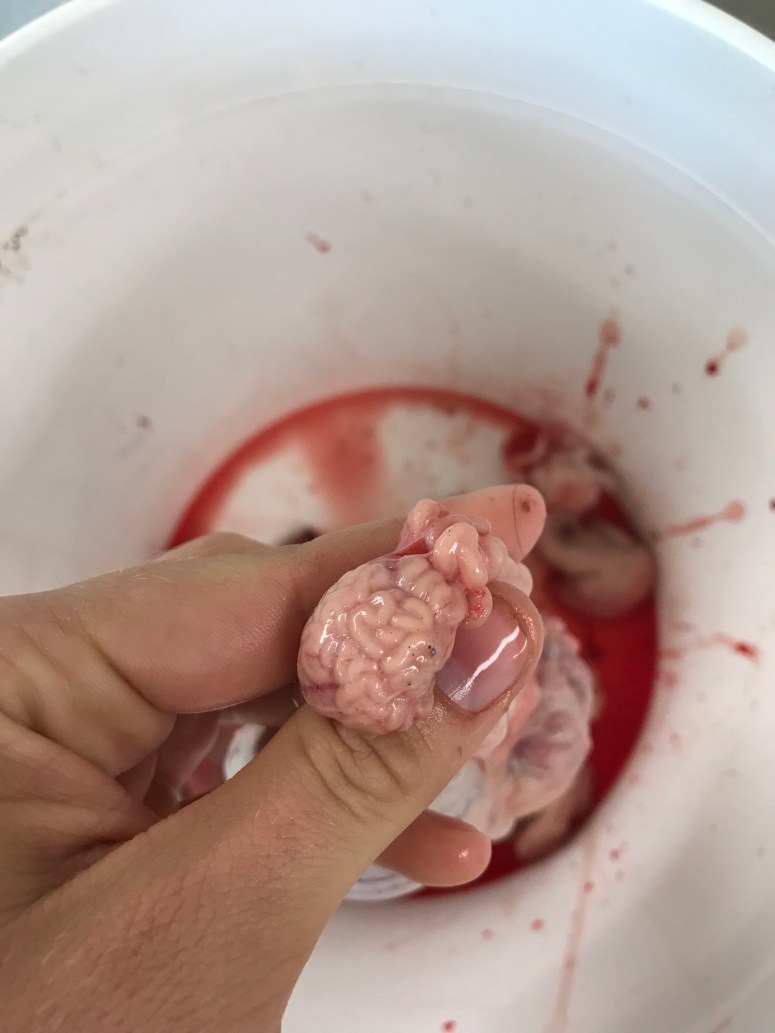
(Excuse my lack of “hand model” hands) Looks like a brain doesn’t it? This is part of the Cauda Epididymis or tail of the Epididymis. As you can see there is a torturous amount of folds in this structure and THAT is how 70-80 meters fit in such a small structure. 2. In order for spermies (as my reproduction professor use to call them) to be produced and mature properly the testes must be 4-6 degrees cooler than the body. 3. The testes are supported by the Cremaster Muscle, it also aids temperature regulation of the testicles. This muscle is located in the spermatic cord and will contract and relax pulling the testes in close or dropping them away from the body depending on the outside weather conditions or situations (fighting or “excitation”) the stallion is facing. Pretty cool huh?
I learned some really cool facts about the role of progesterone (the pregnancy hormone) on neonate foals this past week. The foal while in utero (in the womb) is in a sleep-like state of unconsciousness for the final 75% or so of pregnancy as brain development progresses. This state of unconsciousness is important to reduce movement of the foal and protect the mare from those mile-long limbs the foal exhibits preventing them from causing any damage internally. Progesterone (along with adenosine, allopregnanolone, pregnanolone, prostaglandin D2, and a placental neuroinhibitory peptide) circulate together creating a cranial cocktail. This cocktail paired with the nice comfy in utero environment produces this sleep-like state. I mean, you give me a few cocktails, a comfy blanket and a chair and I’d go to sleep too. The placenta and in utero environment also take care of other basic functions of the foal during this time (meaning that little bugger just mooches for 11 months), waste disposal, “breathing”, supplying nutrients, thermoregulation, etc. During the 20-40ish minutes that encompass the second stage of birth, the contractions act as a sort of punch in the face to the foal causing them to go from the moocher phase to the “do-it-yourself” phase.
How this works is, the cocktail I described above has a “hangover” cocktail antidote if you will. WHAT?! So not fair. There is a huge explanation of how this “hangover” cocktail works but basically during birth there are a couple of hormones that skyrocket in circulation, acting as “wake-up” juice to the foal. This counter cocktail is essential in waking the foal from it’s sleep-like state to the state we are used to seeing once they are born, awake, lively, and aware of what they need to do next (stand, eat, poop). Some times this cocktail doesn’t get the chance or proper time to kick in (that’s a sucky day), and it has come to be known as NMS (Neonatal Maladjustment Syndrome or “Dummy Foal Syndrome”). Foals diagnosed with this syndrome often act like they are in a dream-like state, wandering the stall and not really having a destination in mind, sort of like waking up still drunk from the night before (but I wouldn’t know about that..Hi Mom!).
Dr. John E. Madigan headed up a study on this phenomenon and was published on an Open Access Journal from MDPI (where I learned a lot of this awesome knowledge) I’ll post the link to the study below, fair warning, if you are not used to reading scientific studies it is not an easy read. I tried to put it in layman’s terms as best I could. Dr. Madigan came up with a procedure that mimicked the pressure of birth called the Madigan Foal Squeeze. It consists of a series of wraps (with rope) around the foals ribcage, gentle applied pressure for 20 continuous minutes, and the foal falling into a solemn state. Once the pressure of the wrap is released the foal wakes up and acts like they have been re-born, Hallelujah! It has proven to be one of the best alternative “slaps” in the face to foals with this syndrome and its super cool to witness.
Now that you’ve gotten a taste of my uber nerd-ness and a look into what my brain calls cool, let’s get to the cute part of the post.
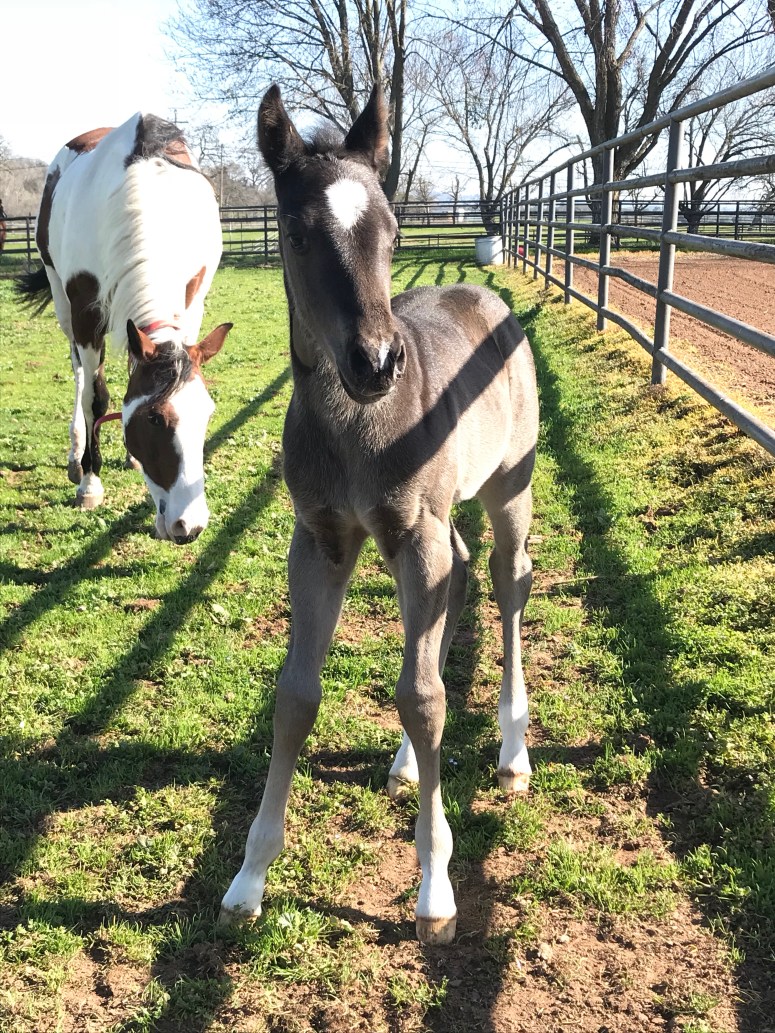
Our first foal was born on Groundhog day! We joked about names like Phil (after the groundhog) or Jimmy (because he was born close to five o’clock and well.. it’s five o’clock somewhere!). But they just didn’t seem to fit. His owner jumped on the first suggestion and so I’d like to properly introduce, Captain:
Our next mare is due on Valentines Day. I’m crossing my fingers and toes that she actually delivers on that day!
The Equine Midwife Facebook page and Instagram are up and running. Tune in there for extra videos, photos, and news in general.
Thanks for sticking with me on this journey! I could talk for days on end about these subjects and ya’ll make it fun!
-The Equine Midwife
Here is the link to the study done by Dr. Madigan: https://www.ncbi.nlm.nih.gov/pmc/articles/PMC5615300/#__ffn_sectitle
 The Equine Midwife